If you’re an artist like me, who works alone in a studio on projects that are solely yours, you’ll understand that sometimes it can feel a bit like working in a vacuum. When you finally emerge from the studio with an artwork or a book to share with the world, you’re never sure if anyone will ‘see’ it quite the way you’d like. In short, your artwork no longer belongs to you, once you share it – it’s open for interpretation, and you have no control over that! So it’s very, very exciting when a reviewer sees your work in the way you hoped someone would.
Betsy Bird’s review of Rumie Goes Rafting, my debut picture book, means a lot to me for that reason – she really ‘gets’ the heart of my intention. When illustrating my Rumie stories, I am trying to make a fantasy world that feels real, with the puppets and props (‘models’) all made by hand and photographed in actual nature, or on sets of a hollow-tree home I make from materials I find in the forest. In her blog, A Fuse 8 Production (School Library Journal), Betsy Bird makes it clear how that process, and the lack of “digital trickery” in Rumie’s world, can bring delight to a reader:
“…So the real danger with models is movement, right? How do you make static figures look like they’re moving on a page? Marentette jumps right in from the title page. There you see Rumie running down a hill towards the water. If there’s any digital trickery at work here, I can’t see it. Then you open the book and boy, it’s lovely. You just can’t fake natural sunlight in the woods, can you? The book tells the story of impatient Rumie and her desire to take a raft for a ride with disastrous consequences. It does a rather delightful job of showing action in a seemingly static form, and I loved how Marentette handled the expressions on the characters’ faces. This one’s a keeper. “
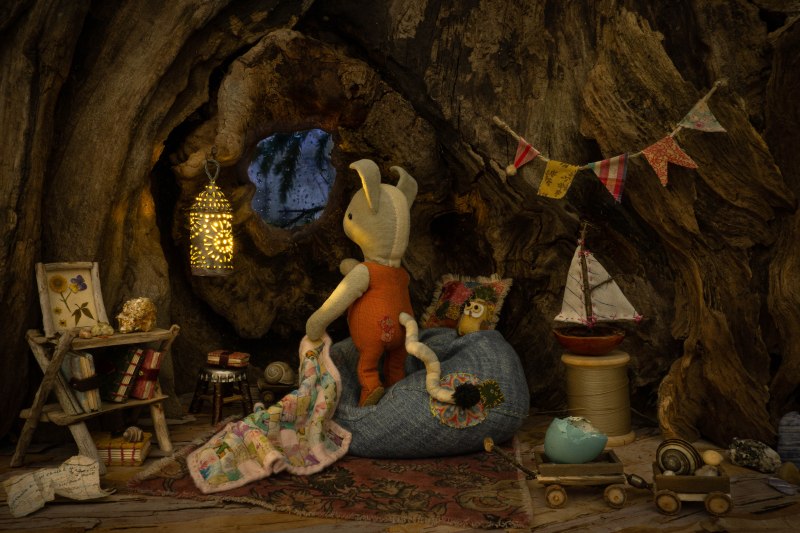
(Insert ecstatic emoji here!) There really couldn’t be a better recognition of my process than this – except from the children who read Rumie! On that front, I am thrilled that some children believe that Rumie is a real creature, living in the woods. I took Rumie’s bedroom set to my book launch and posed a Rumie puppet at the window in the same pose as the scene in the book (see below), and one three year old child said, “But where is the real Rumie?”
He was so convinced that Rumie was real that when he saw the static puppet in person, he thought it was less real because it wasn’t moving, as he believed it was in the book. What a fantastic thing – that a child could take Rumie off the page and into his own imagination, where he can go any time to enjoy Rumie’s kind, creative world…
 Meghan Marentette