My current project is a photo-illustrated picture book series set in nature, of two wire-framed puppet animals I designed. Though my main studio is in the forest (see On Location), I spend a lot of time in a walled studio too, making the puppets, props and indoor sets. The process of making this little world is a delight, even though time consuming. There are usually a lot of failed attempts before the final product, but when something finally works, it feels worth it! Below are some pics from my process:
I’m so pleased to introduce you to Rumie and Uncle Hawthorne. That’s Rumie on the left – a curious young critter who loves to find adventure through creativity, gathering inspiration from various scraps in Uncle’s workshop, or found on the forest floor. Rumie is sometimes a little impatient, but Uncle is always there to lend a helping paw!
All the pieces required to make a Rumie puppet. I made four Rumie puppets and two Uncle Hawthornes in case of mishaps in nature; the puppets get easily get muddy and wet, so I bring extras when I shoot outside. I hand-dyed the fabrics and designed and printed the patterned bits. The inner armature is made of twisted wire, memory foam and magnets. It took 17 prototypes to design the perfect Rumie!
Before I make an interior set, I sketch the image in my head, to guide my prop design and set-up. The final set may not look like the sketch, but it’s the feeling I want to capture. Check out Rumie Goes Rafting to see how Rumie’s bedroom set turned out!
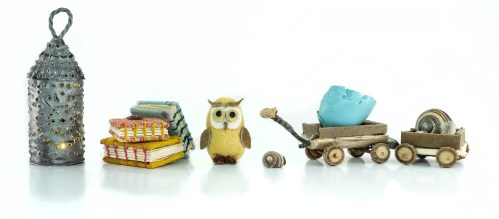
I make the props by hand, learning new skills as I go. The tiny lantern is punched from a sardine tin – I burned it to make it look aged. The stuffed owl toy is Rumie’s sidekick in book two, which I’m working on now. The robin egg is real, found discarded in my garden. I am constantly on the lookout for interesting materials in nature, just like Rumie.
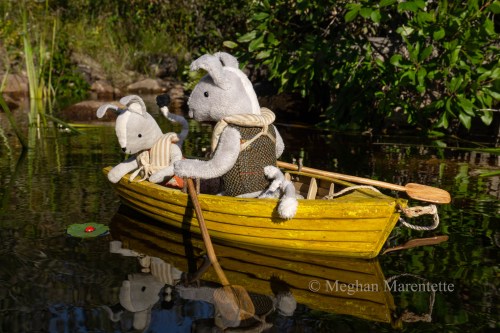
I commissioned my friend Dave Johnson to make a rowboat for Rumie Goes Rafting. Figuring out how to make one myself would have taken me way too long, as each book already takes me years to make! I drew the design and emailed it to him, and he somehow managed to make it exactly as I wanted! I added the rustic paint job to make it look weathered and worn, the tiny life vests and a pine cone life preserver.
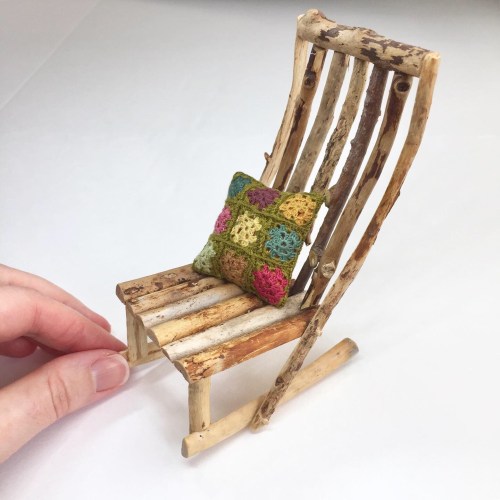
When I make props like a bridge or furniture, I spend lots of time in the woods looking for the right twigs – curved twigs are especially desired! This rocking chair is joined with toothpick dowels. I crocheted this 3 x 3cm cushion with a 1mm crochet hook and embroidery floss. You can find it Uncle’s bedroom, on page 18 of Rumie Goes Rafting.
It comes in handy to have experience drafting patterns and sewing for humans in the film industry. Puppet costumes require the same skills, though small scale presents different challenges. Tiny pieces of fabric fray easily with their narrow seam allowances, so I glue the edges to make sure they last. This is Uncle Hawthorne’s waistcoat in process.
This tiny sweater for Uncle Hawthorne (which will feature in book two) is just 10 cm across the bottom. It was one of the most challenging costumes I’ve ever made – big or small. The stitch chart was mind boggling to design and then navigating several colours of yarn over 1mm bendy needles made for cramped hands! The difficulty was probably tied with this sealskin-lined canvas coat I sewed for Sebastian Koch in Sea Wolf, when I worked in the film industry (below).
(2009, “Sea Wolf”, coat design Martha Curry) I gained extra respect for the Innu, who work with sealskin frequently. It is so stiff and heavy! But the final look made the effort worth it. I prefer making tiny things!
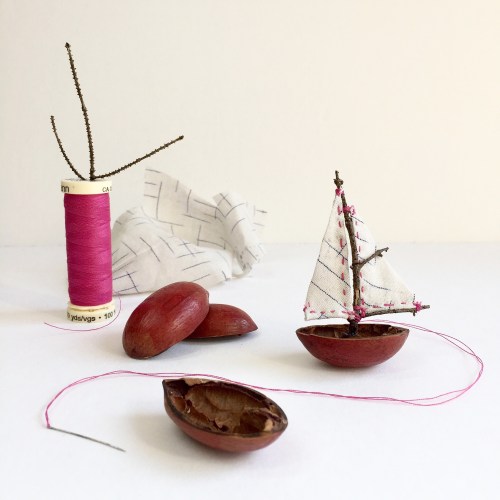
Working on films like Sea Wolf has been important to my artistic journey, as I got to see production designs come to life on set. Set design can make a story more convincing, and the thoughtful work of scenic painters, sculptors, and carpenters is inspiring. As production designer in Rumie’s world, I like to create items out of the materials my characters might find on a forest trail – what could a tiny woodland creature make from a twig, a torn scrap of cloth and a nutshell? Rumie’s toy boat features in Rumie Goes Rafting.
In my stories, I imagine my characters live in hollowed-out trees, connected underground by a maze of tunnels. This stump rotting near my house became a novice sculptor’s nemesis, but I was determined to turn it inside out! After a few hours of careful hacking with a wedge and sledgehammer, I divided it into five pieces, which I later puzzled together as an interior ‘hollow tree’ set.
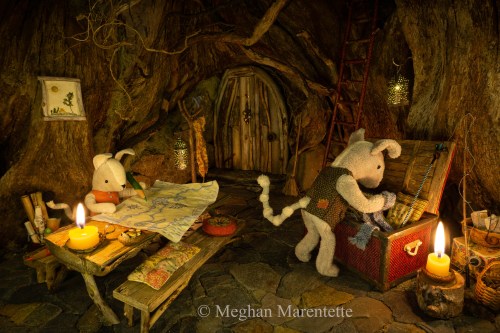
Here’s a corner of the hollowed tree set – an entry into Rumie and Uncle Hawthorne’s home (see final shot of this scene below). I’m brushing sand in between the mini slate rocks, which I collected from a stream and puzzled together over several days. Even though the floor is only a tiny part of the scene, it contributes to the feel of their homemade natural world.
I used real candlelight to light this scene, after a lot of experimenting with electric lights. There is no replacing natural light, and I will never use AI in any of my artwork – what you see in my books actually exists. I am hoping to bring an exhibition of Rumie sets to a gallery in Halifax, Nova Scotia when the second book is released in 2028. I am also working on a Viewmaster reel of 3-D photos of Rumie’s home, so people who live far away will also be able to ‘step inside’ Rumie’s world. Stay tuned!
To see my process in the forest, click On Location.
To read interviews with me about my process and working in nature go here.







 Meghan Marentette